

Written by
GIOPC committee
Global I/O Psychology community
Published
People often talk about burnout like it’s a personal weakness. Something along the lines of they cannot cope, need more resilience or should manage their time better. However, studies tell a different story. They don’t say that burnout is simply about a person running out of energy but rather it may be a signal that something at work may be imbalanced.
In order to support wellbeing, improve performance or discuss the work culture with leaders and employees, a helpful starting point is to ask what exactly are we looking at and that burnout is in the middle of the 3 (wellbeing, performance and culture).
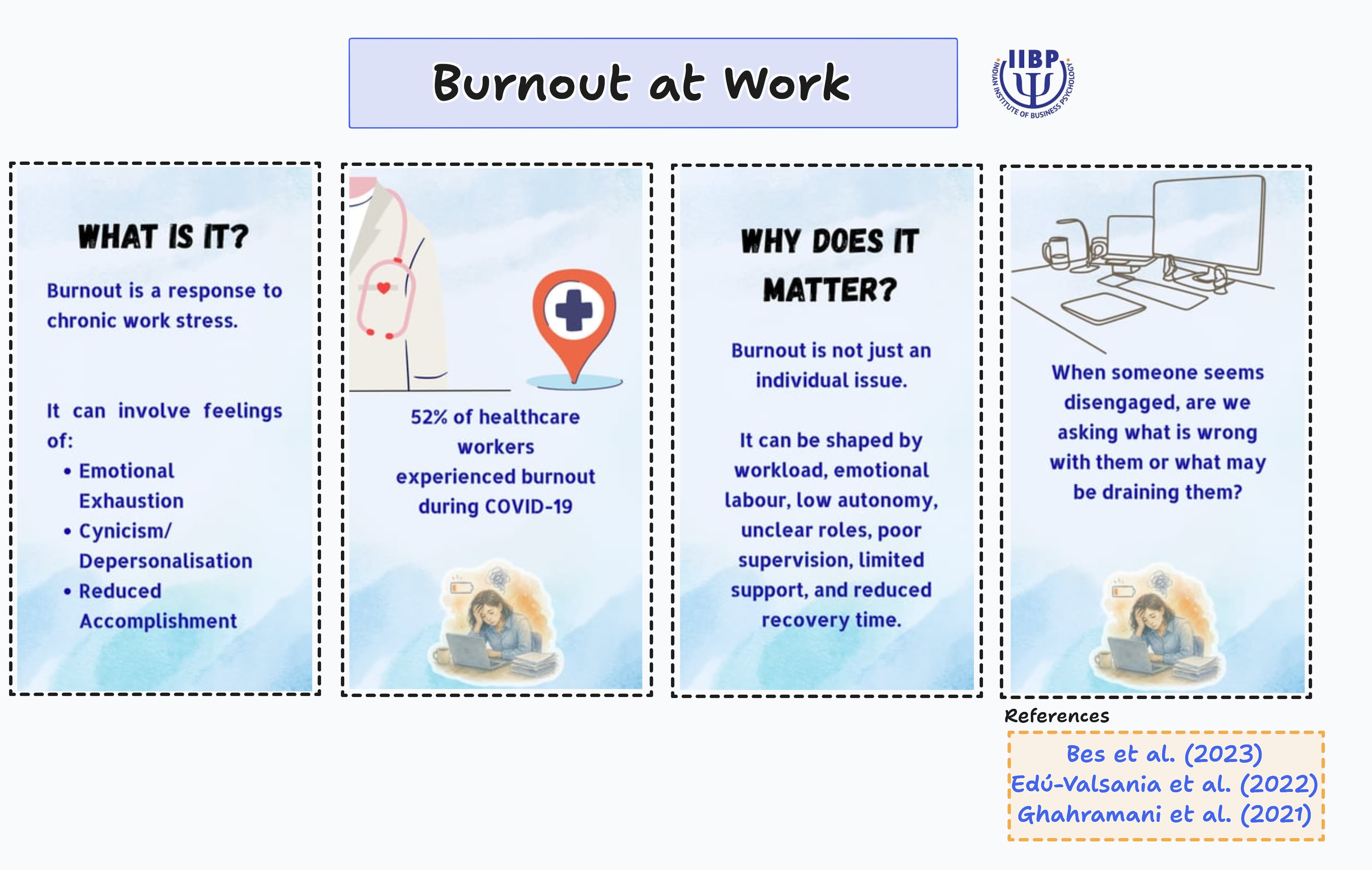
What is burnout?
So how can we understand if someone is experiencing burnout? It can be understood through the following 3 experiences:
Emotional Exhaustion: This includes feeling drained, tired, and unable to give energy at work.
Cynicism or Depersonalisation: This refers to becoming detached, or distant from work or people connected to work like colleagues or managers.
Reduced Personal Accomplishment: This means feeling doubtful, ineffective or
disappointed in our own contributions.
These 3 experiences or even any 1 of them don’t show up suddenly, they may show up gradually and sometimes we may not even realise it. For example: An employee might still be attending every meeting and following deadlines but still feel empty. So when someone says they are burned out, what are they describing? Is it exhaustion, cynicism, feeling unaccomplished or all 3?
How to spot burnout?
This difference matters since burnout isn’t just a simple issue like a flu or a fever as it can develop in different ways and many may not even realise that they are experiencing it. Some employees might become frenetic which means that they keep pushing themselves extremely hard and in the process end up sacrificing on their health because of lack of rest and other factors while others may feel like they aren’t being challenged enough. Hence, they become bored by the work as it starts to feel meaningless or repetitive to them. Then there are some employees who may feel worn out, this is especially the case when they feel like their efforts rarely make a difference.
Here we can also think about an early career employee who is given a task. Initially they may work hard but if instructions are unclear or they feel like most of the decisions that are taken are unfair then they become distant. Eventually, if they feel like nothing they do matters then the employee might look disengaged. However, it could be their response to uncertainty or stress. Hence, we should ask ourselves whether we judge behaviour too fast instead of understanding what may have resulted in it?
How do people get burnout from work?
The way in which work is designed and experienced is important. This is because burnout risks include excessive workload, emotional labour, low autonomy, role ambiguity, poor supervision, lack of social support and working hours or environment which makes recovering from work difficult. This means that there is often discrepancy between demands and resources. Demands aren’t always bad as challenging work can be meaningful. However, they become risky when they are constant and not supported well. Resources include autonomy, feedback, being treated fairly, supportive work relationships and time to recover. So when demands stay high and resources are low then exhaustion becomes more likely than feeling engaged at work.
For example: there are 2 teams in customer service and both have similar workloads. But in one team employees have clear escalation routes, supportive team leaders, realistic targets and some control over their breaks while in the other team targets change without explanation, breaks get missed and supervisors only focus on errors. Here, the work might look alike but the psychological experience that employees in both the teams will have will be very different.
The above example is just one reason why often wellbeing initiatives don’t tend to work. An app for mindfulness might help some employees to pause and regulate stress. However, if workload is unrealistic then the same app might become a risk of just asking employees to tolerate a poor work culture. This doesn’t mean that individual support is not necessary. Peer support, skill training, reflection and recovery habits can definitely be helpful but will only work best when they are paired with organisational changes.
Assessing burnout in the workplace
So burnout can be viewed reflectively by asking questions at all 3 levels:
Individual Level: What is the employee experiencing? What can help them recover and what resources or skills might support them?
Team Level: What are the norms in this team? Is there psychological safety?
Organisational Level: How is leadership, autonomy, fairness, workload shaping the risk of burnout?
If we look at burnout through these 3 levels then we also understand that blaming employees is not the answer here. This redirects us from asking why morale is low to asking which factors might have made it difficult for the morale to sustain?
All in all, burnout is not a problem in individuals. It is feedback from the system. The answer won’t always be the same, it would depend upon the demands, resources, experience, organisation and leaders.
Want to read more?
Check out our Blogs or visit GIOPC community newsletters - our amazing partner for more insightful news!
References
Bes, I., Shoman, Y., Al-Gobari, M., Rousson, V., & Canu, I. G. (2023). Organizational interventions and occupational burnout: a meta-analysis with focus on exhaustion. International Archives of Occupational and Environmental Health, 96(9), 1211–1223. https://doi.org/10.1007/s00420-023-02009-z
Edú-Valsania, S., Laguía, A., & Moriano, J. A. (2022). Burnout: A Review of Theory and Measurement. International Journal of Environmental Research and Public Health, 19(3), 1780. https://doi.org/10.3390/ijerph19031780
Ghahramani, S., Lankarani, K. B., Yousefi, M., Heydari, K., Shahabi, S., & Azmand, S. (2021). A Systematic Review and Meta-Analysis of Burnout among Healthcare Workers During COVID-19. Frontiers in Psychiatry, 12, 758849. https://doi.org/10.3389/fpsyt.2021.758849
Stop Guessing. Start Decoding.
Get weekly psychological frameworks to see what others miss.