

Written by
GIOPC committee
Global I/O Psychology community
Published
Psychological Safety has become an important topic in business psychology and people have been talking a lot about it but what does it actually look like in practice? So is it just about encouraging employees to speak up or is it deeper than that?
What is psychological safety?
Primarily, psychological safety refers to a shared belief that it's safe to take interpersonal risks. Here this means that individuals feel comfortable to ask questions, admit mistakes, offer ideas or challenge the way things are already working without the fear of being embarrassed, punished or rejected. Studies have also consistently linked psychological safety with learning, innovation, collaboration and performance.
However, psychological safety keeps getting misunderstood. People tend to assume that if employees just speak up, then this means that psychological safety must be high yet recent research suggests that the relationship is a lot more complex than this. Some employees might speak up even while they are feeling unsafe while others may remain silent for reasons that are not related to fear. So, how do we understand what employees are really experiencing under their visible behaviour?
An example to understand could be that of an early career employee who noticed some limitations in a project. They have just 2 options:
Raise Concern or Stay Quiet
The decision will not really be straightforward, it’ll depend on several factors like trust on their manager, response from past discussions, respect for colleagues and whether they believe that mistakes will be treated as learning opportunities or as reasons to blame them later on. All of these factors are similar to insights from recent literature which points at psychological safety being shaped by leaders, relationships and the organisational culture.
The inevitables for psychological safety
Trust, respect, supportive communication and inclusive communication are crucial for psychological safety at work. If leaders are approachable, open to feedback and genuinely interested in what employees have to say then it creates an environment where others will feel like contributing their ideas and raising concerns. However, when the leaders are the opposite and the work environment becomes unhealthy due to blaming, poor communication or bad leadership in general then it can discourage participation.
Even if we just think about team meetings and notice how often leaders actually ask for and listen to inputs. What really happens when someone disagrees with what the majority is saying or how mistakes are discussed and if effort is acknowledged? Answering these questions will also help us reflect and understand so much about how psychologically safe we feel at work.
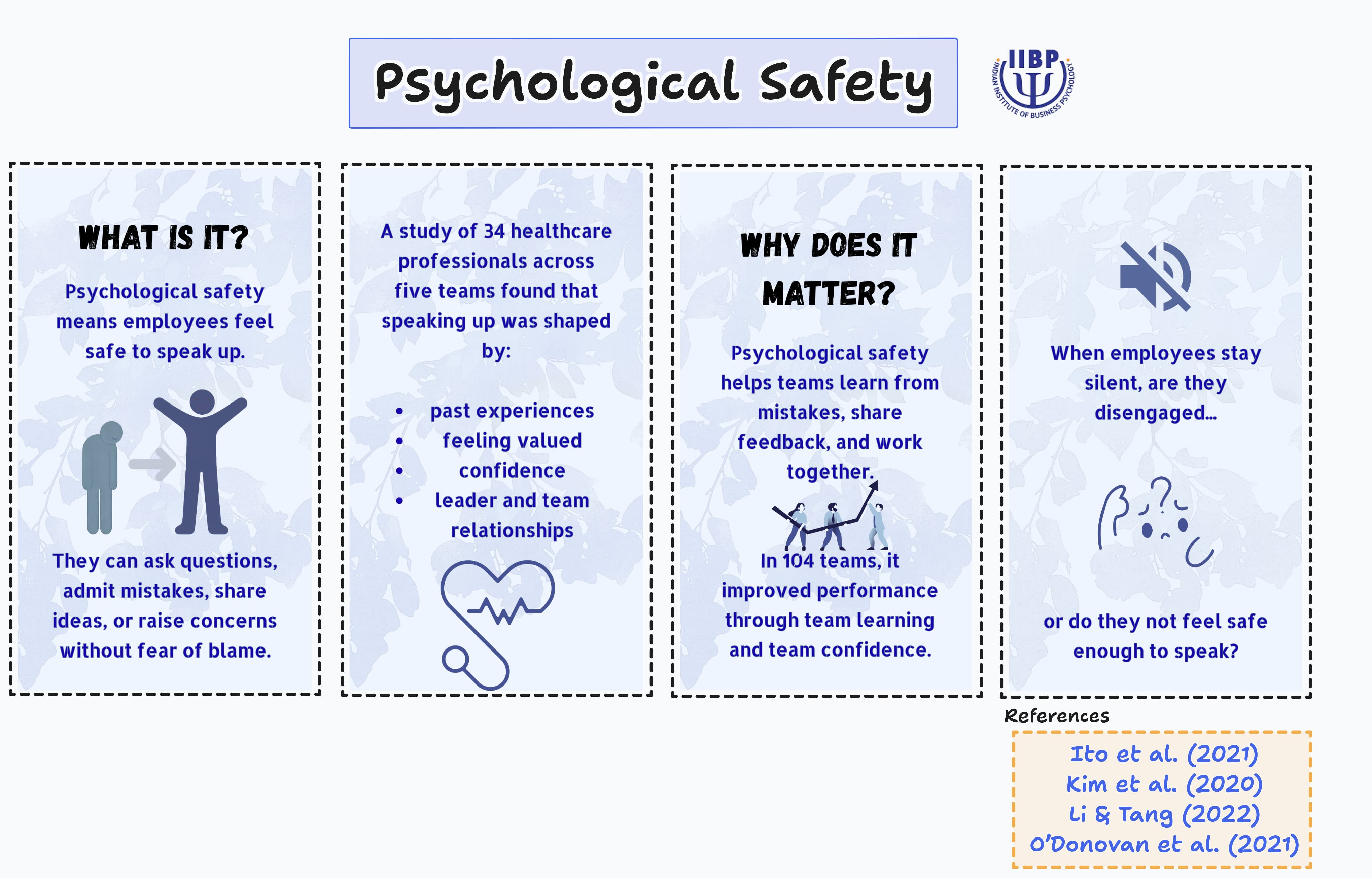
This also suggests that psychological safety doesn’t just work at an individual level or at a team level, it is applicable for both. Some teams might eventually develop their shared norms about speaking up yet individuals in the same team may experience psychological safety differently. This is because personal experiences, confidence, seniority, previous interactions with others and so much more influences how safe employees will feel. It is highly relevant for those early in their career or those who shift jobs since being new at a workplace often includes navigating expectations and uncertainty. Then there are also power dynamics at play along with office politics so new employees might hesitate to speak up. Here, they will not hesitate because what they might want to share doesn’t have value but because they will still be evaluating if the work environment is safe enough for them to take that risk.
Moreover, whether or not they take that risk matters because it also supports learning. When employees feel safe, they ask questions, seek feedback, experiment and admit when they don’t know something. All these behaviors help the team to improve, adapt and grow which indirectly makes performance better by allowing employees to learn and collaborate.
Therefore, psychological safety shouldn’t be the end goal. It should be ingrained in the culture and be consistent so that positive outcomes eventually come from it for both the employees and the organisation. It can be built through small actions that are repeated such as listening, being respectful and treating mistakes as learning opportunities. The question shouldn’t be if I can speak up but about how we can create work environments where speaking up feels expected and safe.
So perhaps the best question to start thinking about is if you have anything to share today at work, would you feel comfortable doing so? Why or why not?
References
Ito, A., Sato, K., Yumoto, Y., Sasaki, M., & Ogata, Y. (2021). A concept analysis of psychological safety: Further understanding for application to health care. Nursing Open, 9(1), 467–489. https://doi.org/10.1002/nop2.1086
Kim, S., Lee, H., & Connerton, T. P. (2020). How Psychological safety Affects team performance: Mediating role of efficacy and learning behavior. Frontiers in Psychology, 11, 1581. https://doi.org/10.3389/fpsyg.2020.01581
Li, T., & Tang, N. (2022). Inclusive Leadership and Innovative Performance: a Multi-Level Mediation Model of Psychological safety. Frontiers in Psychology, 13, 934831. https://doi.org/10.3389/fpsyg.2022.934831
O’Donovan, R., De Brún, A., & McAuliffe, E. (2021). Healthcare professionals experience of psychological safety, voice, and silence. Frontiers in Psychology, 12, 626689. https://doi.org/10.3389/fpsyg.2021.626689
Stop Guessing. Start Decoding.
Get weekly psychological frameworks to see what others miss.