
Written by
GIOPC committee
Global I/O Psychology community
Published
Pay matters and it would be unfair to suggest otherwise. It helps employees meet their basic needs, feel secure and understand if they are being treated fairly. In some situations like during periods of crisis or when there’s pressure, financial rewards and job security becomes even more important. Research on healthcare professions has found that salary, organisational policies, job security and growth can strongly shape motivation (Karaferis et al., 2022).
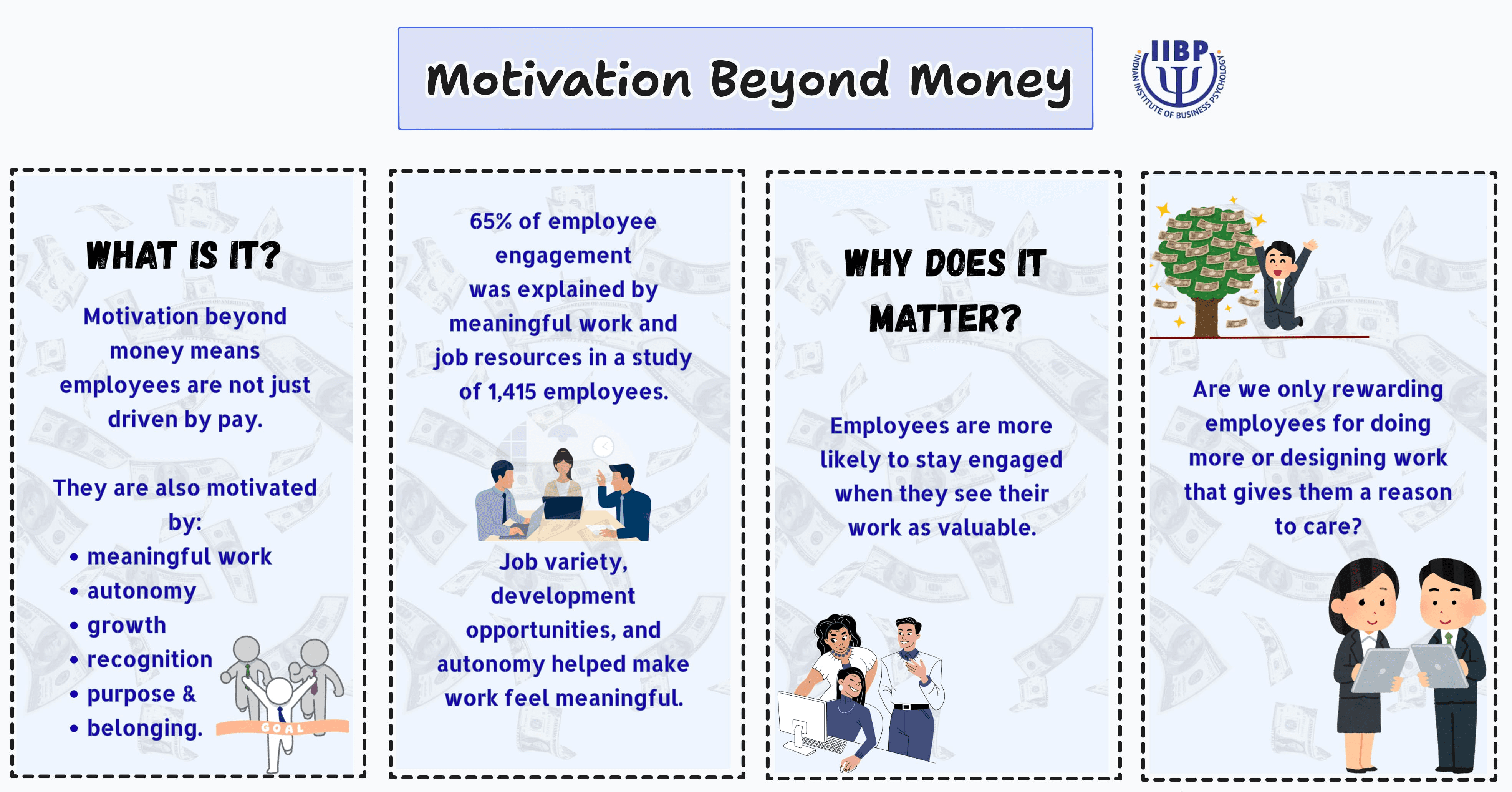
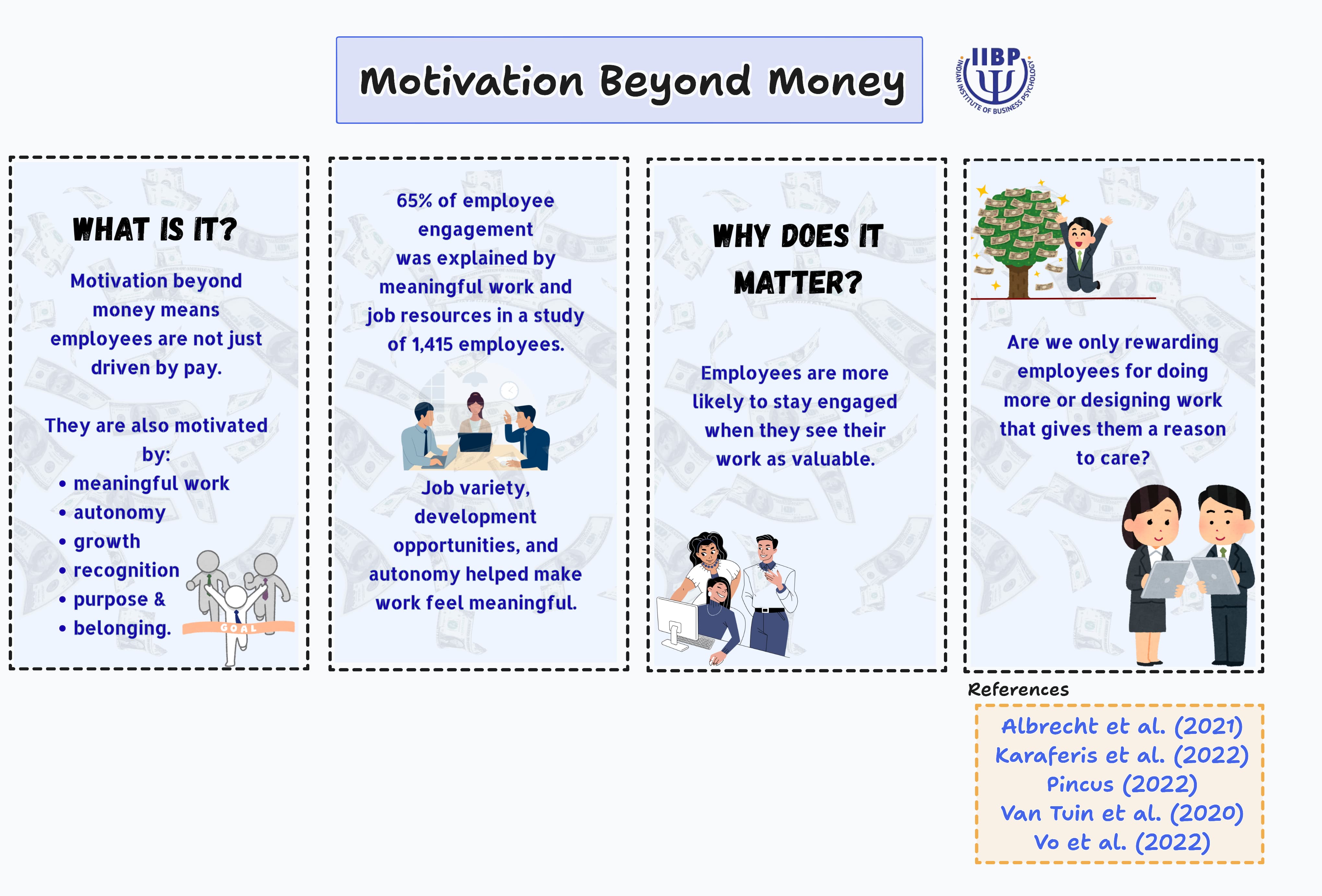
Hence, money is rarely the entire story. Many employees don’t just question how much they are paid but they often wonder quietly whether their work matters, if they’re growing and if they belong? Such questions aren’t financial, they are psychological and they can help us understand motivation beyond money.
What is motivation?
Motivation is so much more than what we might on the surface. Pincus (2022) says that employee engagement is often seen as broad and may be viewed as a mixed up concept. Many concepts are also connected such as performance, wellbeing, purpose, effort, commitment and satisfaction but they are not the same. So, this doesn’t mean that every positive workplace is motivated.
Another strong theme across studies is focused on the self-determination theory which states
that employees feel motivated when work supports 3 basic psychological needs of:
Autonomy: Feeling that we have some choice and flexibility with how we do our work.
Competence: Sense that we have skills and develop them.
Relatedness: Experience of connection with others.
Vo et al. (2022) found that social relatedness and autonomy are positively related with motivation at work across a large sample. However, this doesn’t mean that every employee wants constant collaboration or total freedom but it means that they want to feel capable, trusted and connected.
Pushing just for more work done or true contribution?
This also raises a question for managers to reflect upon: are we just asking employees to do more work instead of actually fostering the conditions that would make them want to contribute?
An important part of the answer is related to meaningful work. This means that employees are more likely to stay engaged at work if they perceive their work as valuable. Albrecht et al. (2021) found that job resources like variety, development opportunities and autonomy are associated with meaningful work which supports work engagement. So, if employees understand the relevance and impact their tasks have they will be more motivated to do them than if they didn’t know why they were doing a particular task.
For example: if a junior consultant is asked to revise some slides, they may see the task as having little to no value. But if they are told that the slides will help clients in making an important decision, then that same task might feel more meaningful to them. Here, the work hasn’t changed but the way in which it was perceived will change the motivation.
Additionally, purpose matters but it needs to be real. Van Tuin et al. (2020) found that corporate purpose is associated with motivation and engagement. Purpose isn’t a slogan or a sentence on some wall or document since employees notice the gap when they see the difference between what their organisation says and what it actually rewards. For example: if a company says that they care about their people but only end up promoting those who work unsustainable hours, then their purpose will lose its credibility.
To actually motivate…
In such situations, asking how can we motivate employees? may not be helpful. Motivation is within employees and also external but it is also shaped by job design, leadership behaviours, team norms, workload, culture, fairness and recognition. So, it’s necessary to ask in what type of environment are we inviting employees? Are they actually going to remain motivated there? An example of this is a small act of recognition. It doesn’t always need to be something expensive, a simple thank you can go a long way when it feels genuine. However, this doesn’t mean that motivation beyond money becomes an excuse to ignore pay.
Therefore, a balanced approach is important. Organisations should ensure basics initially such as pay, respect, security and policies. Then they can build other sources of motivation like meaningful work, development, autonomy, purpose, recognition and belonging. So, keeping employees motivated starts with treating them as human beings rather than performers who carry out tasks. It means designing work that gives them a reason to care, chances to grow and makes them feel like they really matter.
Want to read more?
Check out our Blogs or visit GIOPC community newsletters - our amazing partner for more insightful news!
References
Albrecht, S. L., Green, C. R., & Marty, A. (2021). Meaningful work, job resources, and employee engagement. Sustainability, 13(7), 4045. https://doi.org/10.3390/su13074045
Karaferis, D., Aletras, V., Raikou, M., & Niakas, D. (2022). Factors influencing motivation and work engagement of healthcare professionals. Materia Socio Medica, 34(3), 216. https://doi.org/10.5455/msm.2022.34.216-224
Khusanova, R., Kang, S., & Choi, S. B. (2021). Work engagement among public employees: Antecedents and consequences. Frontiers in Psychology, 12, 684495. https://doi.org/10.3389/fpsyg.2021.684495
Pincus, J. D. (2022). Employee engagement as Human Motivation: Implications for theory, methods, and practice. Integrative Psychological and Behavioral Science, 57(4), 1223–1255. https://doi.org/10.1007/s12124-022-09737-w
Van Tuin, L., Schaufeli, W. B., Van Den Broeck, A., & Van Rhenen, W. (2020). A corporate purpose as an antecedent to employee motivation and work engagement. Frontiers in Psychology, 11, 572343. https://doi.org/10.3389/fpsyg.2020.572343
Vo, T. T. D., Tuliao, K. V., & Chen, C. (2022). Work motivation: the roles of individual needs and social conditions. Behavioral Sciences, 12(2), 49. https://doi.org/10.3390/bs12020049
Stop Guessing. Start Decoding.
Get weekly psychological frameworks to see what others miss.