

Written by
GIOPC committee
Global I/O Psychology community
Published
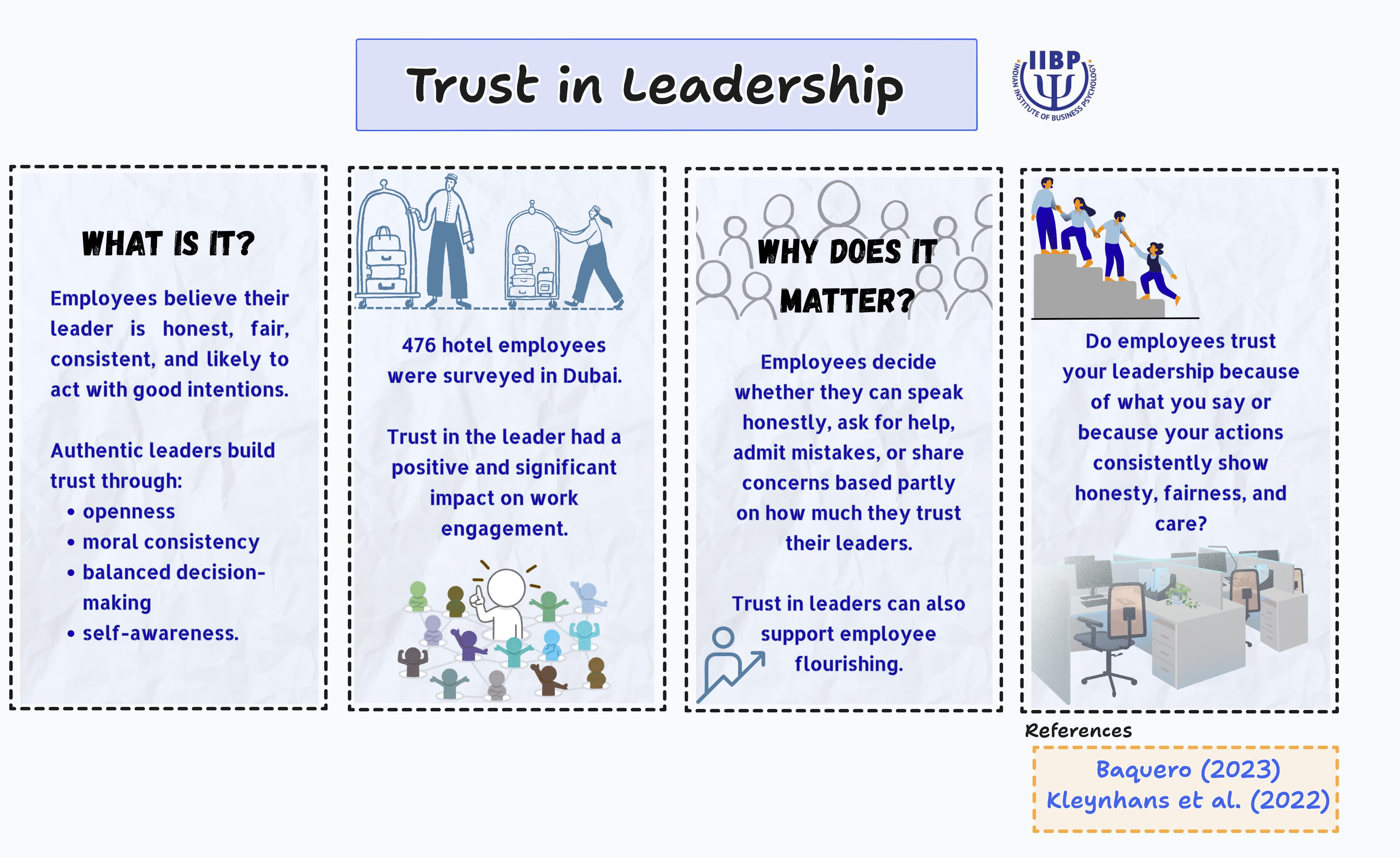
Trust can seem like just a concept, but at work it can be applied and have very real consequences. Everyday employees have to make decisions on whether or not they can speak honestly, try new ideas, ask for help or admit a mistake and all of this gets shaped by how much they trust their leaders.
Authentic leadership and its role in building trust
The Authentic Leadership style is a useful way to reflect on this since they aren’t just good leaders but rather are leaders who act with openness, self-awareness and with a clear moral compass. Hence, they share information and listen to different views before making decisions. They also act in ways that match their values and will admit when they don’t know something.
So when we assess leaders, should we only look at performance outcomes or also focus on the quality of trust that they create?
Research evidence on authentic leadership
To understand more about building trust as a leader, we can look at 2 studies which explore authentic leadership. The first study was in a South African manufacturing organisation which found that authentic leadership is linked with employee flourishing through trust in their leader. So this simply means that employees were more likely to feel and function well at work if they perceived that their leaders were trustworthy and authentic.
Additionally, the relationship between trust and leadership did not weaken with job overload. This doesn’t mean that workload is not important but it may mean that trust remains a meaningful factor even while work feels really demanding.
The second study looked at hotel employees in Dubai, they found that some parts of authentic leadership are connected to engagement at work and trust. Here, relational transparency, internalised moral perspective and balanced processing were important for work engagement while trust in their leader also helped support authentic leadership with it.
So, how can this be applied daily at the workplace?
Applying authentic leadership in the workplace
We can take an example of a team that’s going through restructuring. Roles will be changing, employees might be uncertain and workload may be increasing. In such a situation a leader could still perhaps say that everything is fine, even when employees can see that it is clearly not. It may have been said to be reassuring yet it could reduce trust. Here a more authentic response could have stated clearly that there are some things that the leader can’t confirm yet but that they’ll keep the team updated. This could have been helpful as honesty could have reduced some anxiety that the team may have had, even if it doesn’t remove the uncertainty.
Similarly, when a manager has to make a difficult staffing decision, the approach that they use impacts trust. An inauthentic response would involve asking for inputs but ignoring it whereas an authentic approach would be to genuinely listen, be transparent about the criteria that’s going to be used and acknowledge the impact that it’ll have on everyone. Leaders don’t always need their employees to agree or even like the decision to see it as fair.
Developing authentic leadership
It’s also helpful to keep in mind that authentic leadership is not a personality but rather a behaviour. Hence, we can ask about it, observe it and also develop it. In order to develop it, we can ask some questions which can also be useful in employee surveys and assessments. Questions like how does the leader respond when they are challenged? Do they listen to views that are different from their own? Do they clearly explain decisions? Do their employees feel safe to raise any concerns that they have had? Such questions also remind us that trust is not built through one-off statements but through consistency.
Moreover, just because leadership is authentic doesn’t mean that it has to be perfect. The idea for perfection may even work against authenticity since employees are often realistic. They are aware that leaders face pressure, sometimes have limited information and a lot of demands.
Hence trust isn’t damaged through imperfection, but through inconsistency, poor communication and decisions that are perceived as unfair.
An example of this could be a leader who says that they value wellbeing or worklife balance but then they go ahead and regularly reward employees who work after hours. Similarly, a manager that encourages being open yet often gets defensive to feedback. Such gaps between words and acts is where trust often ends up breaking.
Trust is built through everyday actions
All in all, trust can’t be created by just saying trust me. Employees will only trust their leaders when they repeatedly see them as being honest, fair and willing to listen. So wellbeing and engagement aren’t just individual responsibilities, they get shaped by the social environment that leaders create. Each interaction can be an opportunity for leaders to either build trust or weaken it.
References
Baquero, A. (2023). Authentic leadership, employee work engagement, trust in the leader, and Workplace Well-Being: a Moderated Mediation model. Psychology Research and Behavior Management, Volume 16, 1403–1424. https://doi.org/10.2147/prbm.s407672
Kleynhans, D. J., Heyns, M. M., Stander, M. W., & De Beer, L. T. (2022). Authentic leadership, trust (in the leader), and flourishing: Does precariousness matter? Frontiers in Psychology, 13, 798759. https://doi.org/10.3389/fpsyg.2022.798759
Stop Guessing. Start Decoding.
Get weekly psychological frameworks to see what others miss.