

Written by
GIOPC committee
Global I/O Psychology community
Published
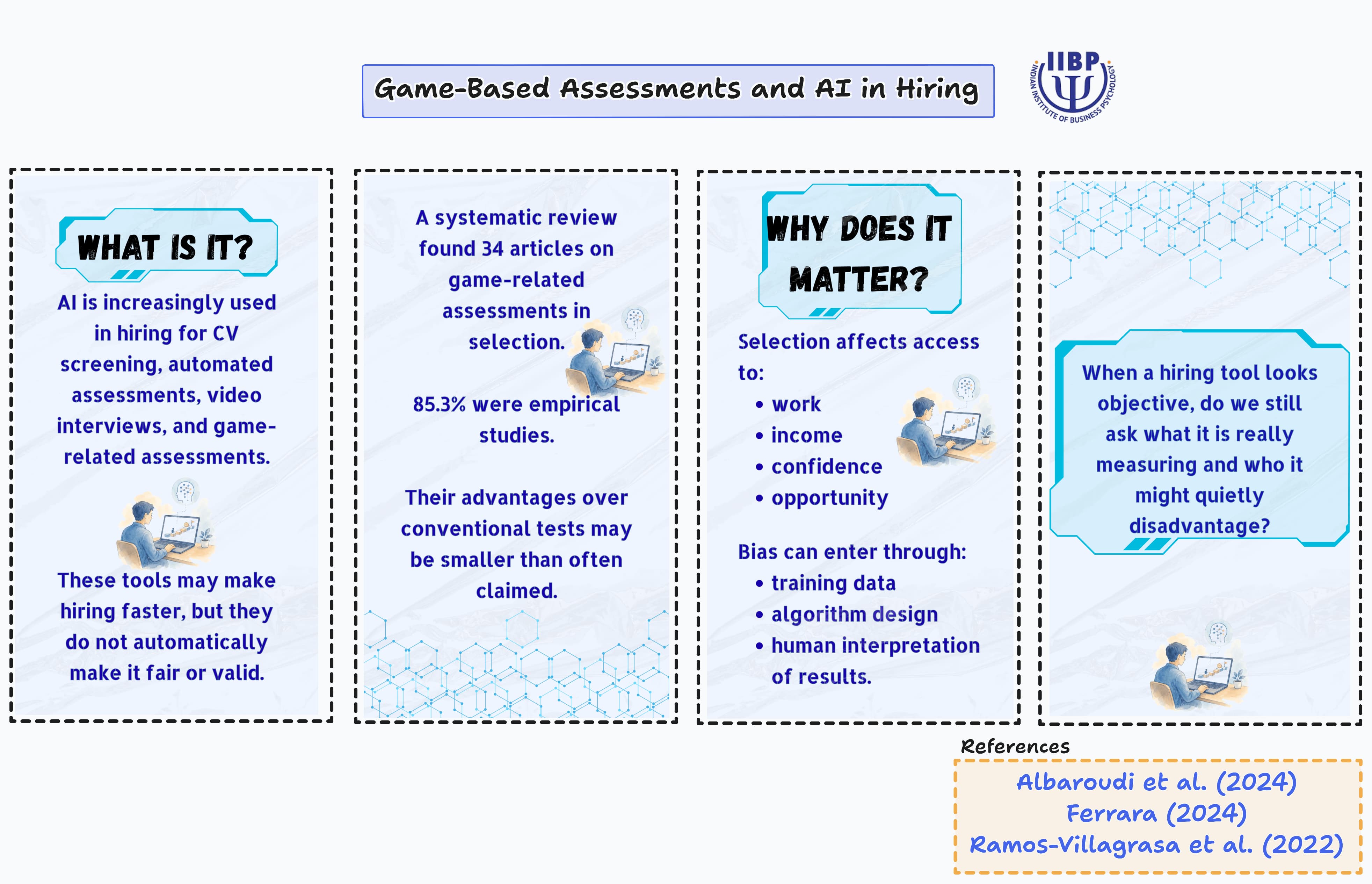
Artificial Intelligence (AI) is becoming a normal part of hiring. It’s used for screening CVs, assessments are getting automated, and video interview analytics has also become common. Even game-based assessments no longer sound like a futuristic idea. So, how can we continue to be open to innovation without losing validity and human judgement? Also, is AI in hiring really fair?
Benefits and challenges of AI in recruitment
These questions matter as selection isn’t just a technical process. It impacts access to work, confidence, income, opportunity and so much more. Hence, when an organisation selects a method for assessment it is now also making a statement about what it values.
It’s true that AI may help teams to hire faster since it can identify patterns in large datasets, reduce subjectivity that people might have and make the entire process highly consistent. However, this doesn’t make AI automatically fair. This is because bias can enter through data used to train a system, the way the algorithm is designed or how the data gets interpreted (Ferrara, 2023). This is an important finding in recruitment as previous hiring data might already reflect unequal opportunities. So, if an AI tool learns from the past without questioning it then it could possibly reproduce the same patterns quietly.
For example: if a company uses what they feel are successful employee profiles to screen applicants then there may be bias, especially if more of the previous hires were from similar universities, or demographic groups. Hence, the tool may treat such indicators as signs of quality. Therefore, a potential candidate with a different background might be scored lower and it wouldn’t be because they lacked potential but because they aren’t similar to the employees that the organisation has always selected. So, even when it feels like it’ll be objective, it’s not. This is because the judgement behind it will still be shaped by past patterns.
Game-based assessments in recruitment
Additionally, there are more layers to AI in hiring which can be seen through Game-based assessments. Such assessments are advertised as being more modern and engaging than traditional tests while also being less stressful. They access personality, cognitive ability, problem solving, risk taking, decision making, alignment with the organisation and so much more through tasks which are like games. This makes it feel like such tests would be viewed as more immersive and people would prefer them over traditional tests. Here, instead of answeringa standardised questionnaire the candidate would have to complete simulations, solve challenges or make choices in environments that are story based.
Validity concerns
However, this doesn’t mean that such engaging tests are valid. Ramos-Villagrasa et al. (2022) suggested that such game based assessments can be used in recruitment and selection but their advantages over conventional methods like psychometric tests and interviews might be smaller than what is often claimed. So, we still need more evidence before deciding on using game based assessments as there are just so many questions that need to be answered on its construct and predictive validity, reactions that the applicants may have, potential bias against some groups and if candidates can easily manipulate their responses.
So let’s suppose that a graduate recruitment process is using a game based test to assess resilience. The game could involve completing games with increasing difficulty under time pressure. Now, this looks really innovative which is why many people won’t question what the game is really measuring. Is it measuring speed, previous experience in similar games, or something else? Someone might continue playing and excel at the game because they find it enjoyable or may have played it before so they are familiar with it. This doesn’t make the person resilient. Hence, without knowing the validity it is possible to get impressed with the format while being unclear about the construct.
Fairness and accessibility issues
Similarly, this can be applied while looking at the fairness of game-based tests. It might decrease some cheating in the tests since candidates may not be sure of what exactly is being tested and how they’ll be assessed yet other issues could arise due to this. There can be accessibility barriers and those familiar with games will have an advantage over those who have never played such games before. Additionally, here the performance could also be influenced by factors such as motor skills, quality of the internet, time pressure, and so much more. So, these factors are no longer small details but rather they end up influencing who gets seen as capable and then gets hired.
Ethical considerations in AI-based hiring
Moreover, tools based on AI for hiring may also create ethical questions about transparency. Candidates might ask about what data the tool is collecting, how it will be scored, if the result could be challenged, whether there’ll be a human in the process, etc. Albaroudi et al. (2024) argued it is crucial to have a collaboration between AI and humans in order to address the algorithmic bias in hiring instead of blindly relying on machines. Therefore, here the goal mustn'tbe to replace judgement but to improve it. So, it’s a very easy and helpful argument to practice as the collaboration will ensure that major mistakes don’t take place before it’s too late.
Who benefits from AI in recruitment?
It’s also important to think about power here. So asking questions like who benefits from the tool and how? Is it the hiring team as their time gets saved or is it the candidate because they get a better test taking experience? Could it be the organisation that’s benefitting as the decisions are getting improved? Ideally, everyone involved should benefit but when the primary motivation becomes efficiency, then the fair may become like an afterthought.
Balancing innovation with fairness
In conclusion, we shouldn’t reject AI or game based assessments in hiring as they can support better hiring when they are carefully designed, monitored and validated. The most useful stance here would be to be curious about what more it can do while also being cautious about what it may hide.
References
Albaroudi, E., Mansouri, T., & Alameer, A. (2024). A comprehensive review of AI techniques for addressing algorithmic bias in job hiring. AI, 5(1), 383–404. https://doi.org/10.3390/ai5010019
Ferrara, E. (2023). Fairness and Bias in Artificial intelligence: A brief survey of sources, impacts, and mitigation strategies. Sci, 6(1), 3. https://doi.org/10.3390/sci6010003
Ramos-Villagrasa, P. J., Fernández-Del-Río, E., & Castro, Á. (2022). Game-related assessments for personnel selection: A systematic review. Frontiers in Psychology, 13, 952002. https://doi.org/10.3389/fpsyg.2022.952002
Stop Guessing. Start Decoding.
Get weekly psychological frameworks to see what others miss.